
Pistol to Rifle Conversion Kits: What You Need to Know

This guide provides a technical and legal overview of pistol to rifle conversion kits, focusing on how these systems work, what to verify before installation, and how to remain compliant under U.S. federal and state laws. You will also find practical comparisons, product references from trusted manufacturers, and internal links to related topics for further research.
Why pistol to rifle conversions attract interest
A conversion kit allows you to enhance a pistol’s performance without purchasing a new firearm. By integrating a stock or extended barrel, you can stabilize the platform, mount optics more effectively, and extend engagement range.
Glock 17 and 19 owners, in particular, use conversion chassis systems to achieve rifle-like stability for training or home defense. However, assembling a pistol into a rifle configuration without understanding federal and state firearm classifications can result in unintended violations.
Before adding any kit, review how the National Firearms Act (NFA) defines rifles, short-barreled rifles (SBRs), and pistols. A firearm’s configuration at the time of assembly determines its classification, not the base pistol alone.
For more on general regulations, review the federal overview in Are Pistol Conversion Kits Legal in the US? and the broader context provided in Pistol Conversion Kit Laws Explained.
How pistol to rifle conversion kits work
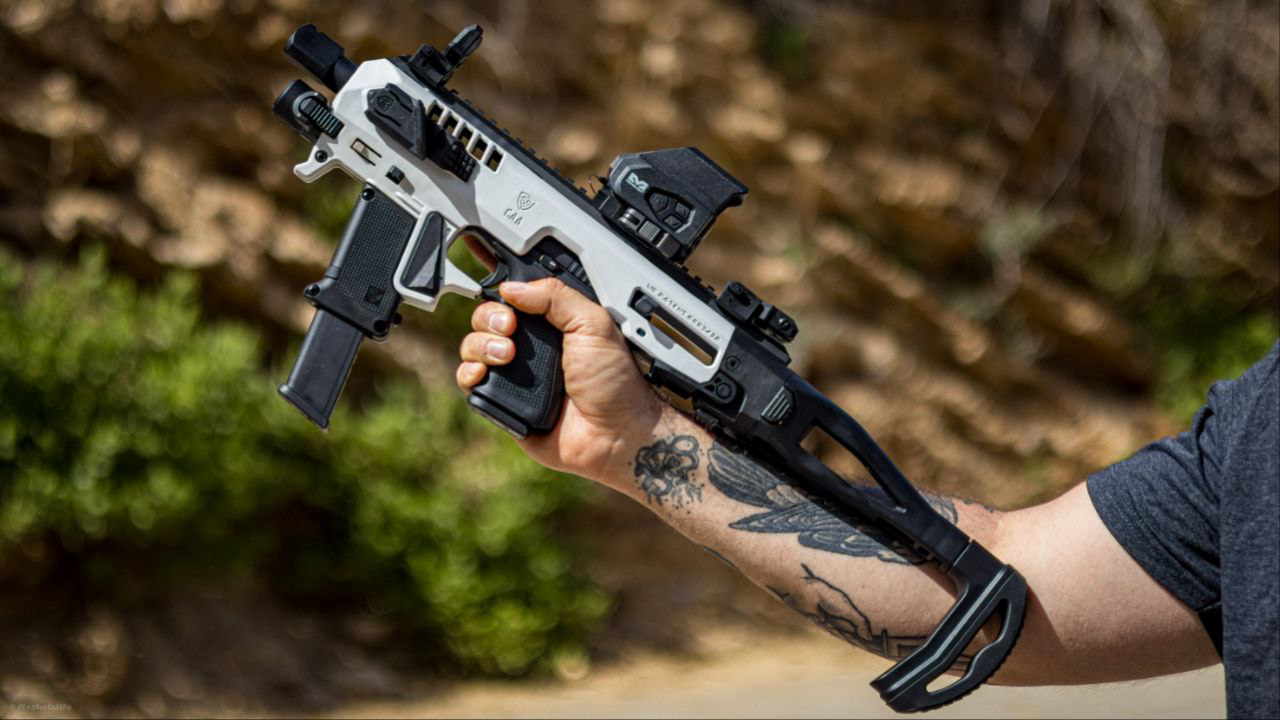
Conversion kits are designed to enclose or extend a pistol’s frame to create a stabilized platform similar to a carbine. The essential function depends on three core components:
- Receiver housing or chassis: provides the main structural interface, often polymer or aluminum.
- Stock or stabilizer assembly: used to shoulder the firearm or provide rear support.
- Barrel extension or adapter: modifies overall length to meet rifle criteria.
The Micro Roni Gen 4X CBS is one example of a chassis capable of rifle-like handling when used with a legal-length barrel. Some models, like the Roni G2, support optics and suppressors but require strict compliance checks to avoid SBR classification.
Understanding the mechanical fit and the legal implications is critical before assembly.
Federal Classification: When a Pistol Becomes a Rifle
Under the NFA, a firearm qualifies as a rifle when it is designed and intended to be fired from the shoulder and has:
- Barrel length ≥ 16 inches
- Overall length ≥ 26 inches
If a pistol is modified to include:
- A shoulder stock or stabilizer capable of shouldering
- A barrel < 16 inches
It may become an SBR, which requires ATF registration and a tax stamp before assembly.
To remain compliant:
- Only attach a stock if the barrel meets the minimum rifle length
- Verify adjustable or folding stocks still meet the 26-inch OAL minimum
For further context, see How to Stay Compliant When Using Pistol Conversion Kits.
Product examples and configuration notes
Here are some kits compatible with popular pistols such as the Glock 19, Glock 17, and similar models. Each example demonstrates different configuration pathways:
- Micro Roni Gen 4X SWAT: tactical variant with folding elements; verify minimum rifle length before shoulder use.
- Micro Roni 4X with Free Thumb Rests: ergonomic version focusing on improved control without permanent shoulder support.
- Roni G2: classic configuration offering extended rail space and reliable fitment for optics and lights.
- Nano Roni: compact platform suited for stabilization without extending to rifle dimensions; useful for training and simulation setups.
These examples illustrate how small component differences, such as folding stocks or removable stabilizers, can change the firearm’s legal status.

Compliance checklist for rifle conversions
Use this checklist before assembling or purchasing a conversion kit that could create a rifle configuration:
- Measure barrel length
- Confirm the barrel is at least 16 inches before attaching a shoulder stock.
- Verify overall firearm length
- Ensure the total assembled firearm exceeds 26 inches when fully extended.
- Confirm federal registration requirements
- File ATF Form 1 for any configuration that results in an SBR.
- Evaluate the stock or stabilizer
- If the part allows shoulder firing, treat it as a rifle component.
- Review state-level restrictions
- Some states, including California and New York, prohibit or restrict conversion assemblies that add rifle features to handguns.
- Store documentation
- Retain serial numbers, purchase receipts, and correspondence confirming your build’s compliance.
For guidance on how state definitions interact with these measurements, review Are Pistol Conversion Kits Legal in California?
States with permissive or undefined classifications
States such as Texas, Arizona, and Florida typically defer to federal definitions, meaning a properly assembled rifle with the required dimensions and registration is lawful to own. However, even in permissive states:
- Keep a copy of your ATF registration if building an SBR.
- Monitor local updates, as city ordinances may vary from state firearm statutes.
| State | Notes | Source |
| Texas | SBR ownership allowed if federal NFA registration requirements are met | US Law Explained: Short-Barreled Rifle |
| Florida | NFA‑registered SBRs allowed; no additional state-level prohibitions | |
| Arkansas | Lawful ownership allowed with federal registration; minimal state-level restrictions | Kent Expertscape: State-by-State SBR Laws |
| Arizona | Defers to federal rules; no additional state barriers beyond NFA compliance | |
| Alaska | Permits NFA‑registered SBRs; state law generally defers to federal rules | Grokipedia: Title II Weapons |
| Idaho | Minimal state restrictions beyond federal NFA compliance | |
| Tennessee | Generally permissive for NFA-compliant SBRs; follow federal process | MBRP Data: State-by-State SBR Laws |
Practical setup recommendations
When setting up your pistol to rifle conversion kit:
- Begin with a chassis-only configuration to test fit and function before adding a stock or extended barrel.
- Use a Micro Roni Gen 4X CBS for its modular stock system if you plan to meet rifle-length requirements.
- Prefer milled aluminum kits for durability when attaching optics.
- Avoid aftermarket parts that lack dimensional or compliance documentation.
For step-by-step technical guidance, see How to Convert a Pistol to a Carbine for detailed mechanical tips on maintaining zero, alignment, and safety.
Legal Considerations (U.S. Law)
- Federal Classification: A pistol converts to a rifle under the NFA when designed to fire from the shoulder, barrel ≥16 inches, OAL ≥26 inches. Violations create an SBR requiring ATF Form 1 approval.
- Shoulder-Firing Accessories: Stocks, rigid stabilizers, or chassis enabling shouldering can trigger SBR classification, even if barrel is compliant. Folding or adjustable stocks must be verified.
- Barrel and OAL Verification: Measure assembled firearm carefully; folding mechanisms can affect OAL.
- State Law Variations: Some states (CA, NY, NJ) impose stricter rules; others (TX, FL, AZ) defer to federal law but local ordinances may vary.
- Registration and Recordkeeping: Maintain serial numbers, receipts, photographs, and assembly logs to support compliance.
- Transport and Interstate Movement: Comply with 18 U.S.C. §926A; SBRs require documentation for interstate travel.
- Manufacturer and Component Compliance: Only use parts with published compliance statements; minor dimensional deviations can trigger violations.
Final Thoughts
Pistol to rifle conversions can provide significant stability and control benefits, but they exist in a tightly regulated space. Always verify that:
- The firearm’s dimensions meet rifle criteria before shoulder-firing.
- All components are sourced from legitimate manufacturers with published compliance statements.
- You maintain documentation proving the configuration’s legality.
For enthusiasts seeking a balance of function and compliance, the Micro Roni Gen 4X CBS and Roni G2 remain solid, documented choices when configured correctly.
Before assembly or modification, confirm current federal rulings, review state laws, and, if uncertain, seek a written determination from the ATF or a qualified firearms attorney.
Related topics and additional resources
For a comprehensive understanding of pistol conversion systems, explore these supporting guides:
- Pistol Conversion Kits: Complete Guide to Types, Laws, and Setup
- Legal & Compliance: Are Pistol Conversion Kits Legal in the US?
- Legal & Compliance: Are Pistol Conversion Kits Legal in California?
- Legal & Compliance: Pistol Conversion Kit Laws Explained
- Legal & Compliance: How to Stay Compliant When Using Pistol Conversion Kits
- Setup & How-To Guides: How to Use a Pistol Conversion Kit for Airsoft
- Setup & How-To Guides: Pistol Conversion Kit for MW3 Players
- Setup & How-To Guides: How to Convert a Pistol to a Carbine
- Comparison & Buyer Guides: Best Pistol Conversion Kits in 2025
- Comparison & Buyer Guides: Pistol Conversion Kit for Glock 19
Each article reinforces different dimensions of the legal and technical environment for conversion kits.