How to Choose the Best Red Dot for a Pistol Conversion Kit


Choosing the best red dot for a pistol conversion kit starts with compatibility. The optic must match the kit's mounting system, fit within the available space, and provide the features required for its intended use.
A higher price, larger viewing window, or longer list of electronic features does not automatically make one red dot better than another. Mounting compatibility, optical clarity, physical dimensions, durability, and cost are all important considerations.
Finding the best red dot means balancing these practical considerations with the available budget. Premium features may offer additional convenience or protection, but they do not automatically make an optic more suitable.
A well-matched red dot provides the necessary compatibility, dependable performance, and useful features without unnecessary cost or complexity.
1. Check Red Dot Compatibility Before Comparing Features
The first step is identifying the mounting system supported by the conversion kit.
Some pistol conversion systems accommodate optics installed directly on the handgun slide. Others provide a dedicated mounting interface or an upper Picatinny rail.
These mounting arrangements have different requirements.
- For slide-mounted optics, compatibility depends on the handgun's optic cut or adapter, the red dot's footprint, and clearance within the conversion chassis.
- For chassis-mounted optics, compatibility depends on the rail or mounting interface, the optic's mounting base, and the surrounding space.
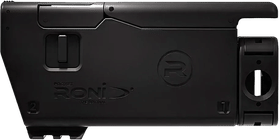
For example, the Nano Roni and Micro Roni Gen 4X use different approaches to optic accommodation.
The Nano Roni accommodates selected pistols with existing slide-mounted red dots, provided the optic and handgun configuration meet the chassis clearance requirements. An optional Pro Charging Handle features an RMSc mounting interface for compatible micro red-dot sights. This accessory is sold separately, included in selected Pro configurations, and is not compatible with Glock 22 or Glock 23 pistols.
The Micro Roni Gen 4X features an upper Picatinny rail for compatible optical accessories. Red dots with other mounting footprints require an appropriate rail-compatible mounting base.
Mounting compatibility must also account for housing dimensions, accessory clearance, and the hardware included with the optic. A matching footprint does not necessarily guarantee that the complete assembly will fit the conversion chassis.
2. Choose the Right Red Dot Design
Red dot sights are available in several housing designs. The three most common categories are open reflex, enclosed-emitter, and tube-style sights.
Red Dot Type | Main Advantage | Main Consideration |
Open reflex | Compact construction and generally smaller housing | The emitter is exposed to environmental contamination |
Enclosed emitter | Protects the emitter within an enclosed housing | Housing dimensions and weight vary |
Tube-style | Enclosed cylindrical design with various rail mounting options | May occupy more mounting space |
Open Reflex Red Dots
An open reflex red dot uses an exposed emitter and a partially reflective viewing lens. Many models feature compact housings, making physical size one of their main advantages.
The exposed design also means dust, water, or debris can interfere with the emitter area under certain conditions.
Enclosed-Emitter Red Dots
Enclosed-emitter sights protect the internal light-emitting component between optical windows.
This construction reduces direct exposure to dust and moisture around the emitter. However, the outside lenses can still become dirty, and an enclosed design does not automatically mean the optic has better impact resistance.
Tube-Style Red Dots
Tube-style red dots feature cylindrical housings and front and rear optical windows. Many are available with compatible rail mounting systems.
Their larger housing dimensions can be a consideration on compact conversion platforms.
Compact open-reflex sights generally occupy less space, while enclosed-emitter models provide additional protection against dust and moisture. Housing dimensions, weight, and mounting compatibility vary between models, making these specifications important when comparing optics for a pistol conversion kit.
3. Compare Reticle Size and Viewing Window
Once compatibility and optic design have been established, reticle characteristics and viewing-window dimensions provide additional points of comparison.
Understanding MOA
Red dot size is usually expressed in minutes of angle (MOA). This measurement describes the angular size of the illuminated dot, not the firearm's mechanical accuracy.
Reticle Size | Characteristics |
2 MOA | Smaller illuminated aiming reference |
3–3.25 MOA | Intermediate dot size |
6 MOA | Larger illuminated reference |
Circle-dot | Center dot combined with an illuminated outer circle |
Different reticle designs can look noticeably different even when the optic housings are similar.
Brightness levels and individual eyesight can also affect the appearance of the dot. For people with astigmatism, an illuminated dot may appear blurred, stretched, or star-shaped.
Red vs. Green Dot Reticles
Reticle color is separate from dot size. Red and green versions of an optic may use the same MOA rating, but the dot can appear differently depending on background, ambient lighting, and individual eyesight. Neither color is universally clearer for people with astigmatism.
Color variants can also have different electrical specifications. For example, Trijicon lists different operating-life ratings for red and green versions of its 3.25 MOA RMR Type 2 RM06:
RMR Type 2 RM06 | Red reticle | Green reticle |
Reticle size | 3.25 MOA | 3.25 MOA |
Battery life | Over four years | Two years |
Test conditions | Brightness setting 4 of 8, 70°F (21°C) | Brightness setting 4 of 8, 70°F (21°C) |
These figures describe two specific product variants; they do not establish a general rule that one reticle color uses more power than the other.
Viewing Window Size
The viewing window is the optical opening through which the reticle and surrounding scene are visible.
A larger window provides a greater visible optical opening, but it may also increase the optic's overall dimensions. A smaller window can help keep the housing compact.
Window size alone does not establish optical quality. Lens clarity, distortion, tint, and reflective coatings also influence the viewing experience.
Two red dots with the same reticle size may offer noticeably different viewing experiences because of differences in lens construction, illumination, and housing design.
Magnification, Parallax, and Eye Relief
- 1× magnification means that the optic does not intentionally enlarge the scene. Conventional red dots are usually specified as 1×, unlike magnifying scopes.
- Parallax is the apparent movement of the reticle relative to a viewed object when the viewing position changes. Many red dots are marketed as parallax-free or operationally parallax-free, but actual behavior and the conditions of those claims depend on the optic.
- Eye relief is the distance between the eye and the optic at which its image can be viewed. Red dots commonly advertise unlimited eye relief, meaning there is no narrow fixed viewing distance such as on many magnified sights. The manufacturer's lens-coating specifications describe reflection and light-transmission properties separately from window size.
4. Evaluate Battery Life, Brightness, and Electronic Features
Battery life, power management, and brightness settings vary between red dot models. These features affect operating time, maintenance, and overall convenience.
Feature | How It Works | What to Consider |
Battery Accessibility | Batteries may be housed in side-loading, top-loading, or bottom-mounted compartments. | Side- and top-accessible batteries can be replaced without removing the optic. |
Battery Life | Operating duration depends on battery capacity, brightness settings, and electronic functions. | Compare battery-life ratings under similar operating conditions. |
Motion Activation | Automatically enters a lower-power state during inactivity and reactivates when movement is detected. | Sleep settings and activation behavior vary by model. |
Solar-Assisted Power | Uses photovoltaic cells to supplement the optic's electrical power under suitable lighting conditions. | Solar assistance depends on available light and the optic's power-management design. |
Brightness Adjustment | Controls the intensity of the illuminated reticle through adjustable brightness levels. | Compare the available settings, including night vision compatibility where applicable. |
Battery accessibility and power-management features can distinguish red dots with otherwise similar specifications. Their availability and performance depend on the individual optic model.
5. Consider Durability, Dimensions, and Overall Cost
A red dot's construction determines more than its appearance. Housing material, sealing, impact resistance, and overall dimensions influence its suitability for different mounting configurations.
Environmental Protection
Two common specifications are:
- IP67: Dust-tight protection and resistance to temporary immersion under defined test conditions.
- IPX8: Water-immersion resistance under specified conditions, without a dust-resistance classification in the rating itself.
These ratings describe environmental protection. They do not establish how well an optic withstands mechanical shock or repeated impacts.
Housing Size and Weight
The optic's overall height, width, length, and weight are important for conversion kits with limited mounting space.
An optic may have a compatible mounting footprint but still present clearance problems because of its housing dimensions or installed mounting base.
Mounting adapters and risers can also change the installed height and overall dimensions of the optic assembly.
Dimensions and Weight of Popular Red Dot Sights
Manufacturer measurements make physical-size comparisons more concrete, but the reported figures must be read in context. Most pistol-reflex specifications describe the optic body; dimensions for an optic sold with a rail mount may describe the assembled package instead.
Red Dot Model | Length × Width × Height | Weight |
1.8 × 1.1 × 1.0 in. | 1.2 oz. | |
1.78 × 1.15 × 1.15 in. | 1.5 oz. | |
1.63 × 1.19 × 0.99 in. | 1.4 oz. | |
3.1 × 2.2 × 2.4 in. (with the specified LRP mount and spacer) | 3.3 oz. (sight only) |
The Aimpoint row deliberately distinguishes mounted-package dimensions from sight-only weight. Those measurements should not be compared as if every row includes identical hardware. Retail configurations, adapters, and product revisions can change the installed size.
Price and Warranty
A higher price may reflect differences in materials, optical construction, electronic features, warranty coverage, or brand positioning. However, price alone cannot establish whether an optic is suitable for a particular conversion kit.
A less expensive optic with confirmed compatibility and the required features may be a more appropriate purchase than a premium model with an incompatible mounting interface.
Warranty coverage, replacement parts, and technical support are additional considerations when comparing products with otherwise similar specifications.
Understanding Warranty Coverage and Product Authenticity
A limited lifetime warranty does not necessarily provide lifetime coverage for every component. Electronic systems may have shorter coverage periods, and the starting date can differ by brand.
Brand | Warranty Coverage |
Trijicon | RMR Type 2 LED electronics: five years from the original manufacture date |
Holosun | Covered commercial models: lifetime coverage of the housing and optical system, with ten years for the illumination system from manufacture; product registration is required |
Aimpoint | Ten years from purchase for personal use; two years for professional or competition use |
Warranty conditions, exclusions, and eligible purchasers should be checked for the exact model. Retaining purchase documentation and confirming the seller is authorized can also help resolve questions about product authenticity and warranty service.
Red Dot Warranty Registration and Service Requirements
Warranty periods explain how long selected components may be covered; they do not explain how a customer submits a claim. For example, Holosun's commercial warranty requires product registration and provides different coverage periods for the housing and optical system versus the LED illumination system. It also excludes certain problems arising from normal wear, modifications, or unauthorized maintenance.
For a Holosun service request, the warranty claim form requests the model number, serial number, place of purchase, and a description of the issue. Owners should retain the purchase receipt, product identifiers, and any correspondence authorizing service. A manufacturer warranty claim is different from a retailer's return policy or a change-of-mind return.
Customers outside the United States should review the applicable regional process before shipping an optic: Holosun's published terms assign international warranty shipping, insurance, duties, and related costs to the purchaser. For current conditions, consult the manufacturer's warranty, product registration, and claim support pages.
6. Compare Your Final Red Dot Options
After identifying compatible models, comparing their specifications side by side helps distinguish essential features from optional additions.
Comparison Factor | What to Check |
Compatibility | Confirmed mounting interface and supported configuration |
Optic design | Open reflex, enclosed emitter, or tube-style |
Reticle | Dot size, selectable patterns, and visual clarity |
Viewing window | Dimensions, lens clarity, and distortion |
Battery | Battery type, accessibility, and published operating life |
Electronics | Motion activation, solar assistance, and brightness settings |
Durability | Housing construction, water resistance, and impact specifications |
Physical fit | Installed dimensions, weight, and available clearance |
Ownership cost | Optic price, necessary adapters, and warranty coverage |
Compatibility determines which optics can be considered for a particular setup. Among compatible models, differences in optical quality, construction, maintenance requirements, and cost provide a more meaningful basis for comparison.
Examples of Red Dot Designs Available on the Market
The Trijicon RMR Type 2, Holosun HS407C X2, Holosun EPS-RD-2, and Aimpoint Micro T-2 illustrate differences in emitter construction, mounting interfaces, battery systems, and housing design.
Optic | Design | Reticle | Direct Mounting Interface | Battery | Characteristics |
Trijicon RMR Type 2 RM06 | Open reflex | 3.25 MOA | RMR footprint | CR2032 | Forged aluminum housing; different mounting packages |
Holosun HS407C X2 | Open reflex | 2 MOA | RMR footprint | CR1632 | Solar Failsafe, Shake Awake, and side battery tray |
Holosun EPS-RD-2 | Enclosed emitter | 2 MOA | Holosun K footprint | CR1620 | Sealed emitter and included RMR-to-K adapter |
Aimpoint Micro T-2 | Enclosed tube-style | 2 MOA | Aimpoint Micro mounting interface | CR2032 | Available with dedicated Picatinny mounting hardware |
What Comes Included With Each Red Dot?
Similar-looking listings can contain different accessories, even when they use the same optic body. The package designation, not just the product family, determines which items are supplied.
Product / Model | Included Accessories and Mounting Options |
CR2032 battery, specified screws, sealing plate, wrench, manual, and warranty materials; no rail mount included | |
Includes RM33 low Picatinny rail mount, plus listed battery, screws, sealing plate, and documentation | |
Listed screws, lens cloth, multi-tool, manual, and warranty card; a Picatinny rail mount is not listed | |
Includes an RMR-to-K adapter plate, listed screws, lens cloth, multi-tool, manual, and warranty card; the adapter is not itself a Picatinny rail mount | |
Includes an LRP mount, 33 mm spacer, CR2032 battery, and Aimpoint tool |
Manufacturers may publish different included-item lists for different SKUs or revisions. Check the exact retailer listing and manufacturer's packaging documentation rather than assuming that every version includes a battery, adapter, or rail mount.
Trijicon RMR Type 2 RM06
The Trijicon RMR Type 2 RM06 combines a 3.25 MOA adjustable LED reticle with a forged aluminum housing and an open-emitter design. Its illumination system runs on a CR2032 battery housed beneath the optic, unlike models that use externally accessible battery trays.
The RMR Type 2 is also available in different mounting packages. The RM06-C-700672 is supplied without a rail mount, while the RM06-C-700673 includes Trijicon's RM33 low Picatinny mount. This distinction affects the mounting hardware included with the sight rather than its reticle or basic optical construction.
Holosun HS407C X2
The Holosun HS407C X2 uses an RMR-pattern mounting footprint and displays a single 2 MOA dot through a 0.91 × 0.63-inch viewing window. Its open-reflex housing is constructed from 7075-T6 aluminum and carries an IP67 rating for dust and water resistance.
A side-accessible CR1632 battery powers the reticle, with Solar Failsafe providing supplementary power and Shake Awake managing illumination during periods of inactivity. Unlike the RMR Type 2 RM06, the HS407C X2 allows access to its battery through an external tray.
Holosun EPS-RD-2
The Holosun EPS-RD-2 also features a 2 MOA reticle, but its LED emitter sits inside an enclosed optical housing rather than an exposed reflex arrangement. The sight uses a Holosun K mounting footprint and comes with an RMR-to-K adapter plate for supported mounting configurations.
Its electronics operate on a side-accessible CR1620 battery and include Shake Awake power management without Solar Failsafe. The EPS-RD-2 also carries an IPX8 water-resistance rating, distinguishing its environmental specification from the IP67-rated HS407C X2.
Aimpoint Micro T-2
The Aimpoint Micro T-2 uses an enclosed, cylindrical optical housing with a 2 MOA illuminated dot. Powered by a CR2032 battery, it has a operating life of 50,000 hours under specified conditions and is rated for submersion to 25 meters.
The Micro T-2 uses the Aimpoint Micro mounting interface and is available with different mounting packages. Product number 200467 includes an LRP mount and a 33 mm spacer for attachment to a compatible Picatinny rail, giving it a different mounting arrangement from the dedicated pistol-reflex footprints used by the other three optics.
Choosing a Red Dot for Nano Roni and Micro Roni Gen 4X
These two Roni systems accommodate red dots in different ways.
Nano Roni
The Nano Roni accommodates selected pistols with existing slide-mounted red dots. The sight stays attached to the handgun, so its housing must clear the chassis. Nano Roni also has a Picatinny accessory rail, separate from the Gen 4X's upper optic rail.
Micro Roni Gen 4X
The Micro Roni Gen 4X features an upper Picatinny optic rail. Roni's MRDS Micro Sight with Red Dot is offered for Micro Roni systems. Other optics may require a Picatinny base that matches their native interface.
Picatinny Mounting Options for the Micro Roni Gen 4X
The featured optics use the following mounting interfaces and rail-mount options:
Red Dot Sight | Native Interface | Picatinny Mounting Option |
Trijicon RMR Type 2 RM06 | RMR | RM33 low Picatinny mount or another compatible RMR rail base |
Holosun HS407C X2 | RMR | RMR-compatible Picatinny mount |
Holosun EPS-RD-2 | Holosun K | Compatible rail-mounting solution; the included RMR-to-K adapter is not a Picatinny mount |
Aimpoint Micro T-2 | Aimpoint Micro | Compatible Micro-pattern rail mount, such as the LRP mount |
These options describe mounting interfaces; the complete optic-and-mount assembly must also fit the available chassis space.
Red Dot Maintenance, Lens Cleaning, and Storage
Red-dot lenses often have specialized coatings that can be scratched or damaged by improper cleaning. Clear away loose surface dust before wiping the glass. For the HS407C X2, the care instructions call for lens cleaner or clean water, followed by suitable lens tissue, soft cotton, or a clean microfiber cloth. They caution against dry paper products and solvents such as alcohol or acetone on the lenses.
Battery compartments, seals, and external controls also require care appropriate to the specific model. Keeping battery contacts and compartments clean and following the supplied instructions for extended storage can help avoid unnecessary maintenance problems. A device stored for a long period may have different battery-handling recommendations from one used regularly.
Avoid opening a sealed optic housing to investigate suspected internal faults. Unapproved disassembly can compromise seals and may affect warranty coverage. Damaged components or persistent electronic problems are better addressed through the product's service and support process.
Common Mistakes When Comparing Red Dot Sights
Several common assumptions can lead to incorrect product comparisons.
- Assuming all red dots fit Picatinny rails: Many compact optics require separate mounting hardware.
- Treating similar footprints as identical: Small mechanical differences can prevent proper compatibility.
- Judging durability by housing material alone: Construction, sealing, and documented testing also matter.
- Comparing battery-life claims without conditions: Published figures can depend on different brightness levels and testing methods.
- Assuming a chassis supports every optic-ready handgun: Physical clearance and model-specific restrictions still apply.
- Treating the highest-priced optic as the best: Price alone does not establish compatibility, optical quality, or suitability.
A meaningful comparison starts with verified specifications rather than unsupported universal claims.
Frequently Asked Questions
What should I look for when choosing a red dot?
Start with mounting compatibility, then compare reticle appearance, viewing-window size, battery features, construction, dimensions, and warranty coverage.
Is an enclosed red dot better than an open reflex red dot?
An enclosed-emitter design offers additional protection around the emitter. Open reflex models often provide a more compact housing. Neither design is universally better across every model and application.
Is a 2 MOA or 6 MOA red dot better?
Neither is automatically better. MOA describes the angular size of the illuminated dot. The appropriate option depends on reticle visibility, individual visual preferences, and the available optic designs.
Do all red dots fit a Picatinny rail?
No. Some include compatible rail mounts, while others use dedicated footprints such as RMR, RMSc, or Aimpoint Micro. Those designs require appropriate mounting hardware.
Can I use an existing pistol red dot with a Nano Roni?
Selected optic-ready pistol configurations can be accommodated, but the exact pistol, optic housing, and chassis clearance must be confirmed.