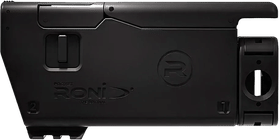

Micro Roni vs Recover Tactical: A Glock Chassis Comparison


Micro Roni and Recover Tactical offer different approaches to pistol chassis design, from compact stabilizing frames to enclosed carbine-style systems. Both brands support popular Glock handguns, but their products differ in construction, mounting systems, included components, and model compatibility.
The comparison extends beyond two competing products. Micro Roni offers the Nano Roni, Micro Roni Gen 4X, and Roni G2, while Recover Tactical's lineup includes the 20/20N, 20/20X, S-Pro, and P-IX+. Each system has a distinct chassis layout, and some accommodate handguns or accessories that others do not.
The differences become clearer when examining the complete platforms rather than comparing brand names alone. A compact open-frame stabilizer has different physical characteristics from a fully enclosed chassis, while a modular system with interchangeable handgun adapters serves a different purpose from one designed for a specific pistol configuration.
Micro Roni vs Recover Tactical: Overview
Micro Roni generally uses compact or enclosed chassis designs, with variations in accessory space and rear-support systems. Recover Tactical offers both open-frame stabilizers and more extensive conversion chassis, including designs with modular adapters and AR-style components.
The seven products examined here represent different approaches to chassis construction.
Product and Price Comparison
The following prices reflect published U.S. product listings checked in October 2026. Figures represent advertised starting configurations rather than equivalent accessory packages.
Model | Listed Price | Design | Distinguishing Characteristics | Warranty |
Nano Roni | $199 | Compact chassis | Reinforced polymer, two-click retention, low-profile construction | Lifetime Warranty |
Micro Roni Gen 4X | $289 | Enclosed modular chassis | Adjustable front shroud on supported configurations, integrated light provision | Lifetime Warranty |
Roni G2 | $449 | Carbine-style chassis | Polymer-and-aluminum construction, integrated foregrip, folding stock | Lifetime Warranty |
Recover 20/20N | $99.95 | Open-frame stabilizer | Glass-reinforced polymer, handgun-sight accessibility, optional rails | 3-year limited** |
Recover 20/20X | $199.95 | Extended stabilizer chassis | M-LOK front shroud, accessory rails, forward magazine carrier | 3-year limited** |
Recover S-Pro | $299.95 | Modular metal-frame stabilizer | Interchangeable handgun adapters, spring-loaded rear support | 3-year limited** |
Recover P-IX+ | $299.94 | AR-style pistol chassis | Multiple Picatinny rails, safety-selector interface, adjustable trigger system | 3-year limited** |
Prices exclude the handgun and may change with configuration, promotions, or included accessories.
Design and Construction: How the Chassis Systems Differ
Micro Roni and Recover Tactical use different chassis architectures, ranging from compact polymer frames to enclosed systems with integrated controls and accessory mounting surfaces. The main structural differences involve how much of the handgun is enclosed, how the chassis is constructed, and which components are built into the frame.
Both brands use reinforced polymers in several models, but their designs are not identical. The Roni G2 combines polymer and aluminum, Recover Tactical's S-Pro uses a metal structural frame, and the P-IX+ adopts a more extensive AR-style enclosure.
Nano Roni: Compact, Low-Profile Construction
The Nano Roni uses a reinforced-polymer chassis designed around a compact enclosure. Its streamlined housing incorporates a side charging hatch, a tool-free two-click retention system, and a quick-deploy rear brace.
Unlike larger enclosed conversion systems, the Nano Roni has fewer integrated structural components and accessory mounting surfaces. The design also incorporates a Picatinny interface without extending the chassis into a full-length carbine-style housing.
The retention mechanism is one of its distinguishing construction features. Rather than using a more extensive hinged chassis compartment, the Nano Roni relies on a compact locking arrangement to secure a compatible handgun within its frame.
Its smaller enclosure provides a different physical layout from the Gen 4X, although it also leaves less room for integrated mounting provisions and additional chassis components.
Micro Roni Gen 4X: Enclosed Modular Chassis
The Micro Roni Gen 4X uses a reinforced-polymer housing that surrounds more of the handgun than the Nano Roni. The chassis incorporates a dedicated handgun compartment, an insertion hatch, and an external locking indicator.
A hinged trigger-guard cover provides an additional protective barrier around the trigger area. The housing also incorporates a charging-handle interface, allowing the chassis to accommodate the operating components of supported handguns without replacing their internal mechanisms.
The front assembly includes an adjustable shroud on supported configurations, while the upper and side sections provide integrated accessory mounting surfaces. A dedicated front sleeve is also incorporated for compatible lighting equipment.
The Gen 4X's modular construction extends to its rear assembly, with different stock and stabilizer configurations available across the product family. These arrangements share the general chassis architecture but use different rear-support components.
Compared with the Nano Roni, the Gen 4X uses a more extensive enclosure with additional integrated mechanisms, mounting locations, and external controls.
Roni G2: Traditional Carbine-Style Construction
The Roni G2 combines reinforced polymer and aluminum in a carbine-style chassis with a folding stock and integrated foregrip.
Its housing incorporates a full-length upper Picatinny rail and additional side rails. These mounting surfaces are part of the chassis structure rather than separate accessories required to establish the basic rail arrangement.
The folding stock and foregrip also form part of the standard design. This distinguishes the G2 from the Nano Roni's compact frame and the Gen 4X's range of rear-support configurations.
The G2 uses a drop-in handgun enclosure while retaining the pistol's original operating components. Its larger exterior structure accommodates the integrated stock, foregrip, and continuous upper rail within one chassis design.
Unlike the predominantly polymer Nano Roni and Gen 4X, the G2 uses a combination of polymer and aluminum components. The material difference is documented, although the available specifications do not establish that it has greater overall impact resistance than the other chassis.
Recover Tactical 20/20N: Open-Frame Stabilizer
The Recover Tactical 20/20N uses a glass-reinforced-polymer frame that leaves much of the handgun's slide and upper assembly exposed.
Its construction differs from the enclosed Micro Roni systems because it does not surround the handgun with a full-length upper housing. Instead, the stabilizing frame incorporates a rear brace and structural attachment points around the compatible pistol.
The open layout preserves access to the handgun's existing sighting system. It also avoids the extensive front shroud and integrated rail structure found on larger chassis designs.
Accessory attachment is handled partly through optional rail adapters rather than a continuous enclosed chassis with multiple built-in mounting surfaces.
The 20/20N therefore represents a relatively minimal structural approach, with fewer integrated chassis components than the Gen 4X, Roni G2, or Recover P-IX+.
Recover Tactical 20/20X: Extended Front-Shroud Design
The Recover Tactical 20/20X builds on the 20/20 stabilizer architecture with a more substantial forward assembly.
Its glass-reinforced-polymer chassis incorporates an M-LOK-compatible front shroud that extends around the forward portion of the handgun. The shroud adds structural space for mounting interfaces beyond those found on the smaller 20/20N.
The design also incorporates upper and side rails, along with a dedicated forward magazine carrier. The carrier has a push-button release mechanism and occupies its own position on the chassis rather than forming part of the handgun's primary magazine well.
A stock-and-tube assembly forms part of the listed 20/20X configuration, giving the chassis a different rear structure from the standard 20/20N stabilizer.
Although the two models belong to the same product family, the additional shroud, rail structure, and forward carrier make the 20/20X a more extensive chassis rather than simply a differently shaped 20/20N brace.
Recover Tactical S-Pro: Metal Frame and Modular Construction
The Recover Tactical S-Pro uses a metal structural frame, distinguishing it from the glass-reinforced-polymer 20/20N, 20/20X, and P-IX+ systems.
Its chassis incorporates an M-LOK-compatible front shroud and a spring-loaded rear-support assembly operated through a push-button release. These components are integrated into a modular frame designed to accommodate different handgun interface adapters.
The adapter arrangement is an important structural difference. Rather than relying on one fixed handgun interface across all configurations, the S-Pro uses interchangeable components that connect supported pistols to the main chassis.
The system also leaves provisions for selected high-profile slide-mounted optics, reflecting a different approach to the handgun's upper assembly compared with fully enclosed chassis designs.
The S-Pro combines a metal frame, modular interface components, and a spring-loaded rear mechanism. Its design is therefore distinct from both the minimal open-frame 20/20N and the more extensively enclosed P-IX+.
Recover Tactical P-IX+: AR-Style Chassis Architecture
The Recover Tactical P-IX+ uses a glass-reinforced-polymer chassis built around an AR-style external layout.
Rather than leaving the handgun largely exposed, the P-IX+ incorporates a more extensive housing with multiple Picatinny mounting surfaces and dedicated external controls.
Its structure includes a safety-selector interface and an adjustable trigger-control arrangement. These features distinguish it from simpler stabilizer frames that primarily provide external support without reproducing the appearance and control layout of an AR-pattern platform.
The chassis also accommodates selected AR-style accessories and rear-support components through its modular exterior design.
Unlike the S-Pro, which uses interchangeable handgun adapters within a metal frame, the P-IX+ centers on a glass-reinforced-polymer enclosure with integrated AR-style control and accessory interfaces.
These external controls do not replace the internal operating mechanism of the installed handgun. The P-IX+ remains a conversion chassis rather than a separate AR-pattern firearm action.
Construction Strengths and Considerations
The physical designs create different advantages and trade-offs. The comparison below concerns documented construction characteristics rather than independently measured durability, accuracy, or reliability.
Chassis | Design Strengths | Design Considerations |
Nano Roni | Compact reinforced-polymer enclosure; relatively simple two-click retention arrangement | Fewer integrated mounting surfaces and chassis components than larger models |
Micro Roni Gen 4X | Enclosed handgun compartment; integrated access and retention features; modular rear assembly | More extensive housing and greater physical bulk than the Nano Roni |
Roni G2 | Polymer-and-aluminum construction; integrated foregrip, folding stock, and continuous upper rail | Larger carbine-style layout with more fixed structural components |
Recover 20/20N | Minimal open-frame construction; retains access to the pistol's upper assembly | Less chassis enclosure and fewer built-in accessory mounting provisions |
Recover 20/20X | Extended M-LOK shroud; integrated rail structure and forward magazine carrier | More extensive front assembly than the 20/20N |
Recover S-Pro | Metal structural frame; interchangeable handgun interface components; spring-loaded rear assembly | Modular design depends on separate model-specific interface components |
Recover P-IX+ | Extensive AR-style housing; integrated control interfaces and multiple rail surfaces | More complex exterior structure than the open-frame stabilizer designs |
These considerations describe the physical construction of each system. They do not establish a performance ranking, since comparable independent testing of chassis rigidity, impact resistance, and long-term mechanical wear is not available for all seven models.
Glock Compatibility: Where the Differences Matter
Handgun compatibility is not determined by the Glock name alone. Frame size, generation, slide configuration, and external controls can affect which chassis supports a particular pistol.
The seven systems have overlapping Glock compatibility, but their supported model ranges are not identical.
Micro Roni Handgun Compatibility
The Nano Roni and Micro Roni Gen 4X support several of the same standard-frame Glock models.
Glock Category | Nano Roni | Micro Roni Gen 4X |
Full-size | 17, 22, 31 | 17, 22, 31 |
Compact | 19, 23, 25, 32 | 19, 23, 25, 32 |
Crossover | 19X, 45 | 19X, 45 |
The current Nano Roni catalog lists Glock 43, 43X, and 48 configurations as upcoming rather than part of its established standard selection.
The Gen 4X also has chassis configurations for selected CZ and Beretta pistols, extending the product family beyond the Glock models listed above.
The Roni G2 covers a different range. In addition to standard-frame Glock models, it has dedicated configurations for Glock 26, 27, and 33 subcompact pistols and the larger-frame Glock 20 and 21.
Those larger-frame options are a notable distinction from the standard Nano Roni and Gen 4X selections.
The G2 also has handgun-specific versions for the SIG Sauer P226, Beretta 92 series, CZ P-07 and P-09, and Bersa Thunder Pro.
Recover Tactical Handgun Compatibility
Recover Tactical's compatibility varies considerably between its product families.
The 20/20N product listing identifies support for double-stack Glock pistols chambered in 9mm and .357 SIG across Generations 1 through 5. Its listed .40 S&W compatibility applies to specified double-stack models through Generation 4.
The 20/20X extends the product range to selected Polymer80 frames and Smith & Wesson M&P configurations. Its compatibility listing includes certain M&P first-generation full-size and compact pistols with specific frame and control requirements.
The S-Pro uses a different approach. Its interchangeable adapter system supports selected Glock models and other handgun families, including specific Canik, Walther, Springfield, PSA, and SIG configurations.
The P-IX+ concentrates on supported Glock models. Its fitment chart and selected configuration remain the determining references for compatibility.
What About Glock Gen 6?
Glock Gen 6 compatibility cannot be generalized across these chassis families.
Recover Tactical has advertised selected Gen 6 support for the S-Pro, but the supported combination depends on the appropriate adapter and handgun model. Its 20/20N and P-IX+ should not be treated as Gen 6-compatible merely because they accept earlier Glock generations.
The Roni lineup also requires model- and version-specific fitment confirmation. A chassis supporting Glock Gen 5 does not automatically support Gen 6.
For a Micro Roni model, the Find My Roni compatibility tool provides a starting point for identifying the appropriate chassis configuration.
Installation and Handgun Retention
The two brands use different systems to secure compatible handguns within their frames.
The Nano Roni relies on its two-click retention design. The Gen 4X uses a dedicated handgun compartment with an insertion hatch, retention components, and visual locking indication.
The Roni G2 uses a drop-in chassis arrangement that retains the compatible pistol within its carbine-style enclosure.
Recover's 20/20N and 20/20X are designed to accommodate compatible pistols without permanent handgun modification. The S-Pro also offers tool-free handgun installation with the appropriate adapter configuration.
The P-IX+ differs because its more extensive chassis and accessory arrangements can involve additional assembly requirements.
These distinctions concern the hardware and procedures specified for each system. They do not establish that one mechanism is more secure or reliable without comparative mechanical testing.
Installation should follow the exact product instructions, with the handgun unloaded and the chamber verified empty. Unusual resistance, damaged retention components, or uncertain fitment should be assessed before the equipment is used.
Rails, Optics, and Accessory Compatibility
The Micro Roni Gen 4X features an upper Picatinny rail for compatible red-dot sights and additional side mounting surfaces for accessories. The Roni G2 offers a continuous upper Picatinny rail and side rails within its larger carbine-style chassis.
Recover Tactical systems use different mounting arrangements across their product range. The 20/20 series offers optional upper and side Picatinny rails, while extended configurations incorporate additional mounting surfaces, including M-LOK interfaces.
These differences affect which mounting accessories are included with each system and which may need to be purchased separately.
Micro Roni Accessory Systems
The Nano Roni includes a compact Picatinny accessory provision and supports selected pistols with existing slide-mounted optics.
Its optional accessories include front grips, magazine holders, lighting equipment, and optical components. The optional Pro Charging Handle also provides a dedicated micro-optic mounting interface, subject to model-specific compatibility.
The Micro Roni Gen 4X has a more extensive accessory arrangement. Its upper rail accommodates compatible sighting equipment, while side mounting areas and an integrated flashlight sleeve provide additional equipment options.
The Gen 4X is available with accessories such as flip-up sights, thumb rests, slings, and dedicated lighting equipment, either individually or in selected bundles.
The Roni G2 includes a full-length upper Picatinny rail and additional side rails. Its integrated foregrip is standard, unlike the optional front-grip arrangements available for other Roni models.
Recover Tactical Accessory Systems
Recover Tactical uses different mounting arrangements across its lineup.
Model | Accessory Arrangement | Notable Difference |
20/20N | Optional Picatinny rail adapters | Minimal open-frame accessory arrangement |
20/20X | M-LOK front shroud and upper/side rails | Expanded mounting provisions and forward magazine carrier |
S-Pro | M-LOK front shroud and compatible upper rail accessories | Modular equipment options alongside interchangeable handgun adapters |
P-IX+ | Multiple Picatinny interfaces and selected AR-pattern accessories | AR-style control and accessory layout |
The 20/20N and S-Pro also document support for selected slide-mounted optics.
This is relevant because an existing optic attached to a pistol slide may be treated differently from an optic installed on a separate chassis rail.
A compatible chassis does not automatically accommodate every aftermarket slide, optic housing, or raised mechanical sight. Complete accessory fitment remains specific to the equipment involved.
Barrel and Muzzle-Device Considerations
The two product families also differ in their published provisions for threaded barrels, compensators, and muzzle devices.
Nano Roni documentation identifies support for selected threaded-barrel and muzzle-device configurations, with dimensional restrictions applying to the chassis opening.
Recover Tactical lists support for selected compensators on the 20/20N and 20/20X.
Recover also offers the separate 20/20 TFA system, which includes a 16-inch barrel and an extended front shroud. This is not the same product as the standard 20/20N or 20/20X stabilizer chassis.
The TFA changes the barrel configuration of the completed system, making it materially different from chassis-only products that retain the handgun's original barrel.
Any configuration involving replacement barrels, stocks, or regulated accessories must be assessed as a complete firearm under the applicable law.
Package Contents and Warranty Coverage
The listed chassis prices do not represent identical sets of equipment. Base products, rear-support options, mounting hardware, and accessory bundles differ between models.
What Is Included in the Chassis Packages?
The Nano Roni's standard configuration focuses on the compact chassis and its built-in components. Accessories such as a front grip, magazine holder, or additional optic are separate unless included in a selected package.
The Micro Roni Gen 4X has a broader bundle structure. Its Basic package includes sighting and support accessories, the Advanced package adds lighting equipment, and the Pro package adds a red-dot sight and carrying case.
The Roni G2 includes an integrated foregrip, folding stock, and its primary Picatinny mounting rails as part of the base chassis design. A complete optical accessory package remains a separate consideration.
Recover Tactical also offers different included components. The 20/20N can be expanded with optional rails, whereas the 20/20X includes an extended shroud, rail equipment, and forward magazine carrier.
The S-Pro depends on its selected handgun adapter and equipment package. The P-IX+ likewise offers configurations with different rear-support and accessory arrangements built around the same chassis.
These package differences explain why the opening price table should not be read as a direct comparison of identical equipment.
Micro Roni Warranty Coverage
Micro Roni offers a Lifetime Warranty covering manufacturing-related malfunctions that occur during the product's lifetime. The warranty excludes damage or malfunctions resulting from abuse or misuse.
Customers experiencing a manufacturing-related issue can contact Micro Roni's support team with their order details and a description of the problem. Warranty claims are reviewed according to the company's Lifetime Warranty Policy.
Returns and refunds are handled separately under the company's Returns & Refunds Policy.
Recover Tactical Warranty Coverage
Recover Tactical's Refund and Warranty Policy establishes different coverage periods for different product categories.
Most products, excluding specified grip and rail systems and holsters, carry three-year coverage for manufacturing defects in materials and workmanship.
Holsters have five-year coverage, while designated grip and rail systems have limited coverage for the product's defined lifetime.
The policy also excludes damage resulting from misuse, accidents, unauthorized modification, and other specified conditions.
The applicable warranty category matters more than a general warranty badge displayed on a product page.
Legal Considerations for Pistol Chassis Systems
Pistol chassis systems can have different legal implications depending on the complete assembled firearm.
The presence of a shoulder stock, stabilizing brace, replacement barrel, or other component can affect the firearm's classification under applicable law.
In the United States, federal treatment of certain National Firearms Act items changed significantly during 2026.
On October 9, 2026, the Bureau of Alcohol, Tobacco, Firearms and Explosives announced an enforcement-discretion policy covering certain making, registration, transfer, and related requirements for specified NFA firearm categories.
That policy did not eliminate the Gun Control Act's requirements or override state and local restrictions. ATF also states that certain interstate transportation requirements continue to apply to short-barreled rifles and shotguns.
The policy is subject to future legal and regulatory developments, and the treatment of a particular firearm configuration cannot be determined from a product name alone.
For current federal guidance, consult the ATF's October 2026 NFA guidance and the applicable state and local legal requirements.
Conclusion: Micro Roni and Recover Tactical Compared
Micro Roni and Recover Tactical offer different chassis designs rather than equivalent versions of a single platform.
The Nano Roni uses a compact reinforced-polymer enclosure with a minimal accessory arrangement. The Micro Roni Gen 4X expands the chassis architecture with additional mounting provisions and equipment packages, while the Roni G2 incorporates a folding stock, integrated foregrip, and broader handgun-specific variants.
Recover Tactical's 20/20N takes a more open-frame approach. The 20/20X adds an extended front shroud and accessory provisions, the S-Pro combines a metal frame with interchangeable handgun adapters, and the P-IX+ introduces an AR-style control and chassis layout.
The clearest distinctions are structural: chassis enclosure, handgun retention, supported model families, integrated components, and accessory interfaces.
Those details provide a more meaningful comparison than price or appearance alone, particularly when the products include different equipment and support different handgun configurations.
Frequently Asked Questions
Is Micro Roni the same as Recover Tactical 20/20?
No. Micro Roni is a separate product family that includes compact and enclosed chassis designs. Recover Tactical's 20/20N uses an open-frame stabilizing structure with its own handgun compatibility and accessory arrangements.
Does the Nano Roni support Glock 43X or Glock 48?
The 2026 Micro Roni catalog identifies Glock 43X and 48 configurations as upcoming additions rather than part of the established standard Nano Roni selection. Availability and supported generations should be checked against the current compatibility listings.
Which Recover Tactical chassis uses a metal frame?
The S-Pro uses a metal structural frame with model-specific handgun adapters. The 20/20N, 20/20X, and P-IX+ use glass-reinforced-polymer construction.
Does Recover Tactical support Glock Gen 6?
Selected S-Pro configurations have advertised Gen 6 support. This should not be generalized to the 20/20N, 20/20X, or P-IX+ without explicit compatibility documentation.
What is the difference between the 20/20N and 20/20X?
The 20/20N uses a more minimal open-frame stabilizer. The 20/20X adds an M-LOK-compatible front shroud, accessory rails, and a forward magazine carrier, along with different included rear-support equipment.
Does the Roni G2 support Glock 20 and Glock 21?
Yes. The Roni G2 product family includes dedicated configurations for Glock 20 and Glock 21 pistols. These large-frame versions are distinct from the standard Glock 17 and Glock 19 arrangements.
Do these chassis systems require permanent handgun modifications?
Several models are designed to accommodate compatible handguns without permanent modification. However, compatibility and installation requirements differ between chassis versions and accessory configurations.
The Recover 20/20 TFA is a separate conversion system involving a replacement barrel and should not be grouped with standard chassis-only products.
Are accessories included with every chassis?
No. Some products include components such as rails, front grips, or rear supports in their standard configurations, while other accessories are optional or bundled separately.
Product photographs may display equipment not included in the selected package.
Are all pistol chassis systems legally classified the same way?
No. Classification depends on the complete firearm configuration and applicable law. Rear-support components, barrel arrangements, and other installed equipment can affect the legal treatment of the assembled firearm.