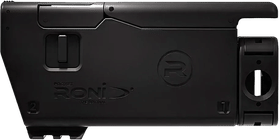

Pistol Brace vs. Stock: Differences and Considerations


Pistol stabilizing braces and shoulder stocks serve different purposes, even when their designs appear similar. A stabilizing brace is intended to support the forearm, while a shoulder stock provides a rear contact surface designed for shoulder support.
These differences matter when comparing pistol conversion chassis such as the Micro Roni Gen 4X. Rear-support design, handgun compatibility, and firearm classification are separate considerations, and understanding each helps explain why a brace and a stock are not interchangeable terms.
Federal developments in 2026 also changed the regulatory landscape surrounding stabilizing braces and certain firearms covered by the National Firearms Act (NFA). However, those changes did not eliminate the physical distinctions between these accessories or the statutory definitions used to classify firearms.
This guide examines the design differences, how they appear in Micro Roni configurations, and the federal legal developments relevant to the comparison.
What Is the Difference Between a Pistol Brace and a Stock?
A pistol stabilizing brace is designed for forearm support, while a shoulder stock is designed to support a firearm against the shoulder. The distinction concerns the accessory's intended function and construction. Although both attach to the rear of a firearm or conversion chassis, they use different support arrangements.
Pistol Stabilizing Brace
A pistol stabilizing brace is a rear-mounted accessory designed to provide support through the forearm. Depending on the design, it may include flexible arm-support surfaces, a stabilizing cuff, or an adjustable strap. These features distinguish forearm-support arrangements from conventional shoulder stocks.
The intended support function is an important product characteristic, but the presence of a brace does not independently establish the legal classification of a completed firearm.
Shoulder Stock
A shoulder stock is designed to provide a rear contact surface that rests against the shoulder. Stocks may feature fixed, folding, or adjustable structures. Some designs use a hinged rear assembly, while others incorporate an adjustable extension that changes the position of the shoulder-contact surface.
These construction differences affect the physical arrangement of the stock but do not change its primary purpose as a shoulder-support component. A shoulder stock is therefore not simply another name for a stabilizing brace.
Pistol Brace vs. Stock: Side-by-Side Comparison
A direct comparison helps distinguish the two accessories without treating every folding or adjustable rear attachment as the same type of product.
Feature | Pistol Stabilizing Brace | Shoulder Stock |
Primary purpose | Provides forearm stabilization | Provides shoulder support |
Intended contact area | Forearm | Shoulder |
Rear-support design | May include an arm cuff, strap, or flexible support structure | Incorporates a dedicated shoulder-contact surface |
Adjustment features | Vary by brace design | May be fixed, folding, rotating, or adjustable |
RONI examples | Micro Roni Gen 4X Brace; Nano Roni | Micro Roni Gen 4X Stock and SWAT; Roni G2 |
Firearm classification | The brace label alone does not determine classification | The completed firearm must be evaluated under applicable statutory definitions |
On the Micro Roni Gen 4X, the Brace configuration is designed for forearm stabilization, while the Stock configuration provides a shoulder-contact surface. The Gen 4X SWAT also uses a shoulder stock, distinguished by its rotating and adjustable design.
The key difference is the support structure: the brace is intended for forearm contact, while the stock is designed for shoulder contact. The SWAT's rotating mechanism is a feature of its stock assembly, not a separate type of support.
How Do Brace and Stock Designs Differ on a Pistol Conversion Chassis?
The differences between braces and stocks extend beyond their appearance. Three design characteristics help distinguish their functions and configurations.
Design Feature | Key Differences |
Rear Contact Surface | A stabilizing brace uses a forearm-support arrangement, which may include straps or flexible support structures. A shoulder stock has a rear surface intended for shoulder contact. |
Folding and Adjustment Mechanisms | Folding mechanisms allow the rear assembly to change position, while adjustable mechanisms change its extension or positioning. These features do not independently determine whether an accessory is legally classified as a brace or stock. |
Chassis and Rear-Support Configuration | A conversion chassis may offer different brace or stock options within the same product generation. However, rear-support selection does not determine handgun compatibility, which depends on the specific chassis configuration and supported handgun model. |
Which RONI Products Use a Pistol Brace or Shoulder Stock?
The Micro Roni product range includes both brace-equipped and stock-equipped conversion chassis. The Micro Roni Gen 4X is a useful example because it offers different rear-support selections within one product family.
Micro Roni Gen 4X Brace vs. Stock
The Micro Roni Gen 4X includes separate Model and Stock Type selections, allowing the handgun configuration and rear-support arrangement to be identified independently.
The following options illustrate the main differences.
Gen 4X Option | Rear-Support Design | Key Features |
Brace | Stabilizing brace | Forearm-support arrangement |
Stock | Shoulder stock | Conventional shoulder-contact design |
SWAT | Adjustable shoulder stock | Rotating adjustable stock assembly |
The Gen 4X Brace incorporates a forearm-support structure rather than a conventional shoulder-contact stock. The Gen 4X Stock provides a shoulder-stock arrangement within the same chassis family.
The Micro Roni Gen 4X SWAT features a rotating adjustable stock. Its rotation mechanism differentiates the rear assembly from the conventional Stock option, while both remain shoulder-stock designs.
These are selected examples rather than a complete list of Gen 4X configurations. SBS is another available product selection.
Nano Roni: An Example of a Brace-Equipped Chassis
The Nano Roni provides another example of a conversion system incorporating a stabilizing brace. Its compact chassis includes a quick-deploy rear brace. This illustrates how a brace can be integrated into a dedicated conversion system rather than offered only as a separate rear-support selection.
The Nano Roni is a distinct chassis platform, not a smaller stock option for the Micro Roni Gen 4X.
Roni G2: An Example of a Stock-Equipped Chassis
The Roni G2 uses a folding shoulder stock as part of its chassis design. The stock incorporates a folding mechanism, while the overall system includes an integrated foregrip and Picatinny accessory rails.
Compared with the Nano Roni's brace-equipped arrangement, the Roni G2 illustrates a stock-equipped system with a different rear-support function and chassis structure.
These products demonstrate how braces and stocks appear across different RONI platforms. Their rear-support features do not establish interchangeability between chassis generations or individual components.
For a broader comparison of the three platforms, see our Nano Roni vs. Micro Roni Gen 4X vs. Roni G2 Comparison.
Does Choosing a Brace or Stock Change Handgun Compatibility?
No. Rear-support selection and handgun compatibility describe different characteristics of a Micro Roni chassis. The Gen 4X product range includes configurations for selected Glock, CZ, and Beretta handguns, along with other specifically listed models.
A product's Model selection identifies the intended handgun configuration, while Stock Type identifies the rear-support arrangement. The availability of brace and stock options within the Gen 4X family does not establish that one chassis fits every supported handgun model.
Handgun compatibility depends on the specific model, generation, and corresponding chassis configuration.
This distinction matters because visually similar conversion chassis may have different handgun interfaces. Rear-support components and handgun-fit requirements should be evaluated separately.
For additional model and generation information, see our Micro Roni Features and Compatibility Guide.
Does a Pistol Brace or Stock Affect Firearm Classification?
Yes. A brace or stock can affect firearm classification, but the legal determination concerns the completed firearm rather than the accessory name alone.
Under 26 U.S.C. § 5845(c), the statutory definition of a rifle includes a weapon designed, made, and intended to be fired from the shoulder, together with other specified characteristics.
A shoulder stock is relevant because its intended function is shoulder support.
A stabilizing brace has a different intended function. However, describing an accessory as a brace does not automatically establish that the completed firearm falls outside the statutory rifle definition.
The assembled firearm's design and characteristics remain central to classification.
How Does This Relate to Short-Barreled Rifles?
A short-barreled rifle, or SBR, is a firearm category addressed by the National Firearms Act.
Under 26 U.S.C. § 5845(a), the NFA definition includes rifles with barrels shorter than 16 inches. It also covers certain weapons made from rifles that meet specified barrel-length or overall-length criteria.
These dimensional provisions apply within the context of the statutory firearm definitions.
A pistol conversion chassis is not automatically classified as an SBR merely because it surrounds a handgun. The assembled firearm's characteristics, including its intended shoulder-firing design, remain relevant. For the statutory requirements, refer directly to 26 U.S.C. § 5845 — Definitions.
Important distinction: A product labeled as a stabilizing brace or shoulder stock does not independently establish the legal status of the completed firearm.
What Changed for Pistol Braces in 2026?
Federal developments in 2026 affected the regulatory treatment of stabilizing braces and the enforcement of certain NFA requirements. These developments are separate from the physical design differences between a brace and a stock.
The 2023 Stabilizing-Brace Rule Was Vacated
ATF introduced additional regulatory criteria for firearms with attached stabilizing braces through a final rule issued in January 2023.
On June 13, 2024, a federal district court vacated the rule in Mock v. Garland. The decision set aside the additional criteria introduced by that rule. It did not remove the underlying statutory definition of a rifle.
On May 6, 2026, ATF issued a proposed rule to remove the challenged stabilizing-brace criteria from the regulations. As of November 18, 2026, ATF identifies this action as a proposed rule.
The distinction is important: the vacatur of the 2023 rule does not mean that every firearm equipped with a stabilizing brace receives the same legal classification.
October 2026 NFA Enforcement Changes
On October 9, 2026, ATF announced a separate nonenforcement policy affecting specified National Firearms Act requirements.
The policy covers certain categories of firearms, including short-barreled rifles, short-barreled shotguns, silencers, and firearms classified as Any Other Weapons (AOWs).
Under this policy, ATF will not enforce specified federal approval, registration, tax-stamp, and related NFA requirements for the covered categories. However, the policy does not repeal the underlying statutory firearm definitions or eliminate all applicable federal requirements.
Gun Control Act provisions remain applicable, and federal nonenforcement does not override state or local firearm restrictions. ATF also continues to require authorization for interstate transportation of short-barreled rifles and short-barreled shotguns under the Gun Control Act.
The complete explanation is available in ATF's updated NFA guidance.
Why Do These Developments Matter for Braces and Stocks?
The 2024 vacatur, May 2026 regulatory proposal, and October 2026 enforcement policy address different legal questions.
The stabilizing-brace rule concerned additional criteria used to determine whether certain brace-equipped firearms should be treated as rifles. The October 2026 guidance concerns enforcement of specified NFA requirements for covered firearm categories.
Neither development makes stabilizing braces and shoulder stocks physically equivalent or establishes a universal classification for all configurations.
A stock-equipped Micro Roni product listing should therefore be understood as a description of its rear-support design, not as a definitive statement about the federal or state legal requirements applicable to every completed firearm.
The distinction between accessory design, firearm classification, and enforcement policy remains relevant.
What Should Be Considered When Comparing a Pistol Brace and Stock?
A meaningful comparison should distinguish the accessory's physical design from the configuration of the completed firearm.
The most relevant considerations are:
- Support Design: A brace is intended for forearm stabilization, while a stock is designed for shoulder support. This remains the primary distinction between the two accessories.
- Rear Assembly Features: Folding, rotating, and adjustable mechanisms describe the physical arrangement of an accessory. Those features are not exclusive to one rear-support category.
- RONI Chassis Configuration: Brace and stock options can exist within the same chassis family, but the specific product selection determines which rear-support arrangement is offered.
- Handgun Compatibility: Compatibility is tied to the supported handgun model and chassis configuration rather than the rear-support designation alone.
- Legal Considerations: Statutory firearm definitions, current federal enforcement guidance, and applicable state or local requirements remain separate from product descriptions.
The central product distinction is illustrated by the Micro Roni Gen 4X Brace and Stock selections: one uses a forearm-support arrangement, while the other provides shoulder support. The SWAT adds a rotating adjustable stock within the Gen 4X lineup.
Frequently Asked Questions
Is a pistol stabilizing brace the same as a shoulder stock?
No. A stabilizing brace is designed to support the forearm, while a shoulder stock provides shoulder support. They have different intended functions and physical characteristics. The legal classification of a completed firearm depends on more than the accessory's name.
Does a Micro Roni Gen 4X stock option determine which handgun models are compatible?
No. The Stock Type selection identifies the rear-support arrangement, while the Model selection identifies the intended handgun configuration. Handgun compatibility depends on the corresponding chassis and specifically supported pistol model.
Did the 2026 ATF updates remove all legal restrictions on pistol braces and stocks?
No. The 2023 stabilizing-brace rule was vacated, and ATF adopted a separate NFA nonenforcement policy in October 2026. These developments do not eliminate statutory firearm classifications, applicable Gun Control Act provisions, or state and local restrictions.