
AOW Rules for Pistols and Chassis Builds


Adding a vertical foregrip to a pistol can change how the firearm is classified under federal law. Although foregrips are commonly used on rifles and pistol conversion chassis, their legal treatment depends on the firearm's configuration, the accessory's design, and whether the finished firearm falls within the National Firearms Act (NFA).
For years, the Bureau of Alcohol, Tobacco, Firearms and Explosives (ATF) has generally classified a concealable handgun fitted with a vertical foregrip as an Any Other Weapon (AOW). Angled foregrips have historically received different treatment, while firearms measuring 26 inches or more introduce additional classification considerations.
Federal enforcement also changed significantly in 2026. The NFA making and transfer taxes for AOWs fell to $0, and ATF subsequently announced a nationwide policy of non-enforcement for several registration and approval requirements.
This guide explains vertical versus angled foregrips, the significance of overall length, and how these questions relate to the Nano Roni and Micro Roni Gen 4X.
What Is an Any Other Weapon (AOW)?
The National Firearms Act establishes several categories of regulated firearms, including short-barreled rifles (SBRs), short-barreled shotguns, silencers, and Any Other Weapons.
Under 26 U.S.C. § 5845(e), the AOW category includes certain firearms capable of being concealed on a person that do not fall within the statute's exclusion for ordinary pistols and revolvers with rifled bores.
The statutory definition also covers certain smoothbore handguns and combination-barrel weapons. However, the principal issue with vertical foregrips involves the distinction between a pistol and a concealable firearm no longer meeting the federal pistol definition.
Why Ordinary Pistols Are Treated Differently
Federal regulations describe a pistol as a firearm originally designed, made, and intended to discharge a projectile while held in one hand, with additional characteristics specified in 27 CFR § 479.11.
This is a classification based on the firearm's design, rather than a requirement that a pistol must always be fired using one hand.
Ordinary pistols with rifled bores are excluded from the AOW definition. The issue arises when a design change causes the firearm no longer to qualify as a pistol, as ATF has historically argued can occur when a vertical foregrip is added.
Why a Vertical Foregrip Can Change Pistol Classification
ATF's Historical Position on Vertical Foregrips
On May 4, 2006, ATF issued an open letter about adding vertical foregrips to handguns.
The letter explained that adding a vertical foregrip creates a firearm designed to be held using an additional forward gripping point. Under ATF's interpretation, that configuration no longer meets the one-handed design characteristics of a pistol.
When the resulting firearm is also capable of being concealed on a person, it can fall within the AOW category.
The letter also described pre-2026 approval and tax requirements. Its historical $200 making-tax and $5 transfer-tax figures are no longer current; the separate 2026 changes are explained below.
The underlying classification issue remains relevant in 2026 even though enforcement of certain NFA requirements has changed.
Why the Grip's Design Matters
A vertical foregrip creates an additional forward handhold. Other rail-mounted accessories, including angled foregrips, hand stops, and magazine carriers, can have different designs and purposes.
A product name or Picatinny mounting interface is not itself a legal classification. ATF's historical position concerns the accessory's actual design and the firearm's complete configuration. This distinction matters with modular pistol chassis.
Vertical vs. Angled Foregrips: What's the Legal Difference?
Vertical and angled foregrips are often discussed together because both provide additional support-hand contact surfaces. Their physical designs differ, and ATF has historically treated certain angled designs differently from conventional vertical foregrips.
Vertical Foregrips
A vertical foregrip generally extends downward from the front of a firearm and provides a distinct forward gripping point. As discussed above, ATF has historically treated its addition to a concealable handgun as potentially creating an AOW. That interpretation concerns the completed firearm, not the accessory in isolation.
Angled Foregrips
An angled foregrip provides a sloped gripping or indexing surface instead of the conventional downward orientation of a vertical grip.
In earlier classification correspondence, ATF concluded that certain angled foregrips, including the Magpul Angled Fore Grip evaluated in its letters, did not independently change an AR-type pistol into an AOW.
Those determinations addressed particular accessory designs and firearm configurations.
They should not be interpreted as blanket approval for every product marketed as an angled foregrip.
An accessory's appearance, labeling, and intended function may all be relevant to its classification.
There is no general statutory angle measurement that establishes an automatic legal boundary between every vertical and angled foregrip.
Hand Stops and Magazine Carriers
Hand stops are generally smaller accessories intended to provide a reference point or help limit support-hand movement along a mounting surface.
Magazine carriers serve a different primary function: providing storage for an additional magazine.
Some accessory designs combine magazine storage with a dedicated gripping surface.
Because of that overlap, calling an accessory a magazine carrier does not necessarily resolve whether its physical design could raise questions about a second handgrip.
Product-specific classification remains important, particularly when the accessory includes a pronounced forward gripping section.
Foregrip Classification Comparison
Accessory | Primary Design | Federal Classification Consideration |
Vertical foregrip | Separate forward gripping surface | Can lead to AOW classification on a concealable handgun |
Angled foregrip | Sloped support-hand contact surface | Certain designs have been found not to create an AOW by themselves |
Hand stop | Compact indexing or stopping surface | Depends on the design and complete firearm configuration |
Magazine carrier with grip | Magazine storage combined with a handhold | Requires evaluation of the accessory's physical design and function |
Shoulder stock | Shoulder-supported firing interface | Raises rifle and potentially SBR classification questions rather than an ordinary pistol foregrip question |
These distinctions describe the general classification framework. They do not establish a legal determination for every accessory sold within a category.
Does a 26-Inch Overall Length Prevent AOW Classification?
Overall length is frequently discussed in connection with vertical foregrips because the AOW definition includes the concept of a firearm being capable of concealment on a person.
Why 26 Inches Matters
ATF has historically considered 26 inches an important benchmark in determining whether certain firearms with forward grips are readily concealable. Some individual determinations treated firearms at or above that length as outside the AOW category when they were not actually concealed.
This is not an automatic 26-inch exemption. The AOW statute focuses on whether a weapon is capable of being concealed on a person; it does not create a universal rule that every firearm measuring at least 26 inches is exempt. Design, actual concealability, and the firearm's other classification characteristics still matter. See the statutory AOW definition.
Why Overall Length Can Be Complicated
Overall length is not always the same as the distance between the two furthest visible points of an assembled firearm.
Federal measurement practices can depend on the type of firearm and the classification being evaluated.Components such as folding braces, shoulder stocks, receiver extensions, and muzzle devices raise different measurement questions.
Historical ATF letters have addressed how particular configurations are measured, but those determinations should not be assumed to apply universally to every modern pistol chassis.
This matters because a compact conversion kit may have several external components without necessarily qualifying for a particular overall-length treatment.
The dimensions shown in a product listing do not automatically establish the legally relevant overall length of a firearm equipped with that product.
Barrel Length and Overall Length Are Different
Barrel length and overall length are separate measurements with different legal significance.
For example, federal rifle definitions incorporate a 16-inch barrel-length threshold, while the NFA also addresses certain rifle configurations based on overall length.
The AOW classification question involving a vertical foregrip is different because it focuses on whether the resulting firearm falls outside the pistol definition and is capable of concealment.
Confusing these requirements can lead to incorrect conclusions about a completed firearm configuration.
What Changed for AOW Registration in 2026?
The federal legal framework changed substantially in 2026. It is important to distinguish between a firearm's statutory classification, the amount of federal tax imposed, and whether ATF is currently enforcing particular requirements.
January 1, 2026: The Federal Making Tax Became $0
Public Law 119-21 amended the NFA making and transfer taxes for covered firearms; see the Congressional Research Service analysis.
Effective January 1, 2026, the federal making tax for an AOW was reduced from $200 to $0. The legislation also eliminated the federal transfer tax for covered AOWs.
Previously, AOW transfers were generally subject to a $5 federal transfer tax, while making an AOW ordinarily carried a $200 tax.
These changes removed the federal tax amounts but did not directly repeal the statutory definitions governing AOWs.
August 2026: Federal Court Decision
On August 5, 2026, the U.S. District Court for the Northern District of Texas issued a decision in Silencer Shop Foundation v. ATF, discussed in ATF's October 9 announcement.
The court challenged the continued enforcement of certain NFA provisions after Congress reduced the making and transfer taxes for covered items to zero.
The resulting injunction applied to specified parties rather than automatically protecting every individual nationwide.
The decision became a significant development in the subsequent federal enforcement policy.
October 9, 2026: Nationwide ATF Non-Enforcement Policy
On October 9, 2026, ATF announced a nationwide enforcement policy addressing AOWs, short-barreled rifles, short-barreled shotguns, and suppressors covered by the federal tax reduction.
Under the policy, ATF is not enforcing several NFA requirements for these covered items, including:
- Prior ATF approval for making or transferring covered NFA firearms.
- Registration in the National Firearms Registration and Transfer Record.
- Certain prohibitions involving unregistered covered NFA firearms.
- Related NFA marking and transportation requirements described in the guidance.
ATF also confirmed that individuals may continue to submit voluntary registration applications.
The agency's position applies nationally as an exercise of enforcement discretion, not solely to the parties included in the Texas injunction.
Interstate transportation has a separate exception. Although ATF is not enforcing the specified NFA restriction on interstate transport of unregistered covered items, the Gun Control Act still requires prior ATF approval for interstate transportation of short-barreled rifles and short-barreled shotguns. ATF states that individuals must continue to file Form 20 for those firearms, whether or not they are NFA-registered. This specific Form 20 requirement should not be confused with the separate treatment of AOWs under ATF's guidance.
The current details are provided in ATF's October 2026 NFA guidance.
Does This Mean AOWs Are No Longer Regulated?
No. AOWs remain defined within federal firearms law.
ATF's current decision not to enforce specified NFA provisions does not repeal those provisions or remove the firearm's underlying statutory classification.
The Gun Control Act continues to apply, including restrictions involving prohibited persons, dealer background checks, recordkeeping, and applicable interstate transactions. State and local requirements may be stricter, and some state laws rely on federal registration status.
ATF has also warned that its non-enforcement policy could change following new legislation, litigation, or an agency decision.
The guidance does not promise permanent protection or a guaranteed future registration window if enforcement resumes.
For that reason, the current policy should not be interpreted as a permanent exemption from all future federal requirements.
How Foregrip Rules Apply to Pistol Conversion Kits
A pistol conversion chassis provides an external housing or support structure, sometimes with accessory mounting surfaces or rear support options. Classification depends on the assembled firearm, not the chassis name.
Does Installing a Pistol in a Chassis Make It an AOW?
Not automatically. An external chassis alone does not necessarily change a pistol into an AOW. The actual forward grip, any shoulder-support component, and the completed design raise separate classification questions that must be evaluated together.
Nano Roni Front Grip and AOW Considerations
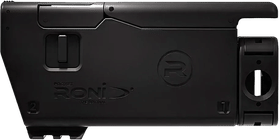
The Nano Roni features a compact reinforced-polymer chassis with Picatinny accessory mounting provisions. Its documentation identifies an ergonomic front grip incorporating a spare magazine holder.
The Nano Roni Grip with Magazine Holder is also available as a separate accessory.
What the Nano Roni Front Grip Does
The accessory combines a forward gripping surface with spare-magazine storage and mounts through a Picatinny interface. Physical fit on the rail does not, by itself, establish a federal classification for the assembled firearm.
How the Nano Roni Front Grip Relates to AOW Classification
The Nano Roni front grip provides a separate forward handhold and spare-magazine storage. Magazine storage is not an exemption from federal foregrip classification rules. ATF’s historical AOW analysis concerns the actual gripping design and the complete firearm, not a product’s marketing name. A Roni-branded front grip does not receive a categorical AOW exemption.
Micro Roni Gen 4X Foregrip Considerations
The Micro Roni Gen 4X uses a larger chassis design and is available in configurations with different rear support components.
Its product documentation also identifies a front-grip arrangement incorporating spare magazine storage on selected versions.
Front Grip and Magazine Carrier
Selected Gen 4X versions have a front grip and extra-magazine carrier, while its installation documentation states that the extra carrier is not included with the stabilizer-brace configuration. Features on one version should not be assumed to appear on every configuration, and product labeling does not independently determine legal classification.
Brace and Stock Configurations Are Separate Legal Questions
The Micro Roni Gen 4X offers different rear support configurations, including stabilizing-brace and stock options.
A shoulder stock can cause a handgun with a barrel shorter than 16 inches to meet the federal definition of a short-barreled rifle.
A stabilizing brace is not automatically classified as a shoulder stock solely because it attaches to the rear of a firearm.
The classification depends on whether the firearm is designed and intended to be fired from the shoulder under applicable federal law.
ATF's 2023 stabilizing-brace rule was vacated or restricted through litigation. On May 6, 2026, ATF proposed removing the challenged regulatory language. That proposal should not be mistaken for a categorical exemption for every brace; the statutory definition of a rifle remains relevant.
Adding a foregrip to a firearm already classified as an SBR does not ordinarily create a separate AOW classification merely because of the foregrip. However, the legality of the complete configuration remains subject to applicable federal and state requirements.
For more general information, see the Pistol Conversion Kit Laws Explained guide.
What Should Be Considered Before Changing a Pistol Configuration?
A product description or accessory's appearance is not enough to settle legal classification. Review four questions together:
- Starting firearm: Is the firearm legally classified as a pistol, rifle, or another category?
- Accessory design: What does the forward attachment actually do, and is there a product-specific determination?
- Complete configuration: How do the host firearm, forward grip, brace, or stock affect the assembled firearm's classification?
- State and local restrictions: Do independent rules apply even when ATF is not enforcing specified federal NFA requirements?
For example, California Penal Code § 30515 addresses features including a second handgrip on certain semiautomatic pistols. The California Pistol Conversion Kit Laws guide provides additional state-specific context. A qualified U.S. firearms-law professional should review uncertain configurations before changes are made.
Frequently Asked Questions
Is a vertical foregrip on a pistol illegal?
Not necessarily. ATF has historically classified a concealable handgun fitted with a vertical foregrip as an AOW. Under its October 2026 policy, ATF is not enforcing specified federal NFA requirements for covered AOWs, but other federal and state laws still apply.
Does an angled foregrip make a pistol an AOW?
Not automatically. ATF has determined that certain angled foregrip designs do not, by themselves, change a pistol into an AOW. Those determinations apply to the specific designs evaluated, not every accessory labeled “angled.”
Does a 26-inch overall length exempt a pistol from AOW classification?
No. ATF has used 26 inches as a concealability benchmark, but federal law does not establish a universal 26-inch AOW exemption. Classification also depends on the firearm's design and concealability.
Do I need ATF Form 1 approval for an AOW in 2026, and what is the tax?
No prior Form 1 approval is required under ATF's October 9, 2026 non-enforcement policy for covered AOWs. The federal making and transfer taxes are both $0 as of January 1, 2026. Voluntary registration remains available; other applicable laws still apply.
Does installing a pistol in a Nano Roni or Micro Roni Gen 4X automatically make it an AOW?
No. Installing a pistol in a chassis does not automatically create an AOW. The completed firearm's design—including any forward grip or shoulder stock—determines which federal classification rules apply.